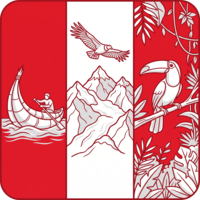
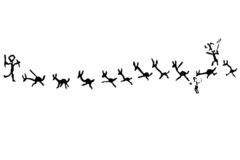
 The history of Peru is not limited to the Inca Empire. Long before its emergence in the 15th century, the pre-Inca period spanned several thousand years. Throughout this vast era, various remarkable civilizations flourished, adapting to the environments of The Andes and the Peruvian coast. These peoples left behind an immensely rich cultural, architectural, and artistic legacy. Studying these pre-Inca cultures is absolutely essential to understanding the development of Andean civilization, as they laid the technological and social foundations that would later culminate under Inca rule.
One of the very first major cultures to develop in Peru was the Caral culture. It flourished between 3000 and 1800 BC in the Supe valley, located about 200 kilometers north of the current capital, Lima. Often considered by archaeologists as the oldest civilization in the Americas, Caral impresses with its ingenuity. The site is remarkable for its monumental structures, housing imposing pyramids and large circular plazas. These remains bear witness to an already highly complex social organization and the mastery of vast trade networks, millennia before the appearance of the Incas.
Following the decline of Caral, many other civilizations succeeded one another, each bringing significant cultural and technological innovations. Among them, the Chavín culture (900-200 BC) stands out as one of the most famous and influential of the pre-Inca period. Emerging in the heart of the central Andes, it is globally known for the construction of monumental temples and its highly elaborate religious iconography. The archaeological site of Chavín de Huántar was one of the main nerve centers of this culture, a place where complex religious ceremonies and rituals were practiced to worship their deities.
Later, along the southern coast of Peru, two great civilizations managed to tame a desert environment: Paracas and Nazca. The Paracas civilization (700-100 BC) is famous today for its extremely colorful textiles and particularly complex funerary practices, including advanced mummification techniques. The Paracas people also showed great ingenuity by innovating in agricultural irrigation systems, allowing them to survive and thrive in an arid desert.
The Nazca civilization (100 BC - 800 AD) then took over in this same region. It is universally famous for the Nazca lines, vast and mysterious geoglyphs traced directly on the desert floor, which still passionately intrigue researchers and archaeologists around the world today.
Simultaneously, in the northern region of Peru, the brilliant Moche civilization (100-700 AD) developed along the coastal valleys. The Moche are universally recognized for the incredible complexity of their ceramics, as well as for their sumptuous royal tombs. They also built enormous adobe brick pyramids, the most famous of which are the Huaca del Sol and the Huaca de la Luna. Through these works of art and monumental architecture, they left an invaluable legacy of mythological tales.
The pre-Inca period concluded with the emergence of two powerful civilizations: the Wari and the Tiwanaku, who dominated The Andes between 600 and 1000 AD. The Wari empire, in particular, distinguished itself by its formidable organizational capacity, establishing a vast network of roads and administrative centers across its territory. These remarkable infrastructures actually served as a direct model for the Incas several centuries later. Because of their unprecedented ability to unify different Andean cultures under a single political authority, the Wari are often considered by historians as the true precursors to the Inca Empire.
In conclusion, the long pre-Inca period was a rich era, marked by major innovations and cultural developments. Although the Incas inherited many practices and knowledge from the civilizations that preceded them, it is crucial to remember that each of the pre-Inca cultures uniquely contributed to the enrichment of Peruvian heritage. Together, they shaped the Andean civilization as we know it today.