In May 2000, President Alberto Fujimori sought a controversial third term against his main opponent, economist Alejandro Toledo. Massive electoral fraud was noted from the first round, prompting Toledo to call for an election boycott. Fujimori managed to get re-elected and began his new term on July 28. However, his government collapsed a few weeks later with the release of damning videos (the famous "Vladi-videos") showing his close advisor, Vladimiro Montesinos, bribing members of Congress.
Cornered by this resounding scandal and by pressure from the international community, Fujimori fled to Japan in November 2000 and attempted to resign by fax. Faced with this power vacuum, the President of Congress, Valentín Paniagua, courageously assumed the interim presidency and called for new, transparent elections for April 2001. This election pitted Alejandro Toledo against Alan García, a former president (1985-1990) returning from exile despite heavy accusations of corruption. With 36% of the votes against García's 24%, Toledo was elected president on June 3, 2001, thus closing the authoritarian parenthesis of the 90s.
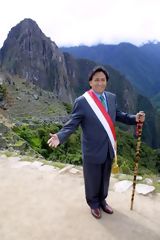 Under the presidency of Alejandro Toledo, Peru maintained a neoliberal line and consolidated structural economic reforms. This period (2001-2006) marked the beginning of strong stability and sustained growth, primarily driven by the mining industry, a booming construction sector, and export agriculture. Foreign investment flowed into the country, and inflation was strictly controlled.
However, despite these excellent macroeconomic indicators, the much-promised "trickle-down" of wealth was slow to materialize. Deep social inequalities remained entrenched, and the government struggled to meet the expectations of rural and Andean populations, who felt excluded from the benefits of this growth.
In 2006, to everyone's surprise, Alan García managed a comeback on the political scene and won the presidency with the promise of reducing poverty while stimulating the economy. Taking advantage of exceptional global economic conditions and the meteoric rise in raw material prices, his government implemented reforms to attract massive foreign capital. The "Peruvian miracle" was in full swing: growth approached 9% in 2010, and the country weathered the 2008-2009 global financial crisis with remarkable resilience.
Unemployment fell, and the poverty rate dropped significantly. However, García's economic model, heavily focused on extraction, provoked serious tensions. Deep conflicts erupted between the government and indigenous communities, who denounced the exploitation of their natural resources and the pollution of their lands without prior consultation.
The 2011 election saw nationalist Ollanta Humala, Keiko Fujimori (the former leader's daughter), and Alejandro Toledo face off. Humala won the election in the second round, driven by a discourse focused on social justice and bridging the gap between the capital and the provinces. Faced with persistent poverty in rural areas despite the country's overall enrichment, his mandate (2011-2016) took a decidedly social turn.
His administration created the Ministry of Development and Social Inclusion and launched major welfare programs, such as Juntos (which financially supports vulnerable families) and Pensión 65 (an allowance for destitute seniors). Nevertheless, his government faced the same pitfalls as its predecessors: violent protests paralyzed several mining regions, where extractive projects were perceived as a direct threat to the environment and local livelihoods.
Starting in 2016, Peru entered a zone of severe institutional turbulence. Pedro Pablo Kuczynski (PPK) narrowly won the election against Keiko Fujimori but faced a Parliament dominated by the Fujimorist opposition. Tainted by the repercussions of the Odebrecht corruption mega-scandal (which would eventually implicate all living former Peruvian presidents), PPK was forced to resign in 2018.
His vice president, Martín Vizcarra, then took the reins of power. Popular for his fierce fight against corruption and his bold dissolution of Congress in 2019, he was ultimately impeached in a highly controversial move by lawmakers in November 2020, at the height of the COVID-19 health crisis. A lightning crisis ensued: Manuel Merino remained in power for only five days before being overthrown by massive protests, giving way to Francisco Sagasti's transitional government.
In 2021, rural teacher and unionist Pedro Castillo caused a surprise by winning the presidential election. But his mandate, marked by inexperience, record ministerial instability, and a permanent conflict with Parliament, ended abruptly in December 2022 when he attempted to illegally dissolve Congress. He was arrested and replaced by his vice president, Dina Boluarte.
Dina Boluarte's rise to power triggered a wave of social protests of unprecedented magnitude, mainly in the southern Andes, which were severely repressed. Her administration struggled to regain legitimacy and restart an economic engine slowed by global inflation and growing insecurity.
The end of her mandate plunged the country into a new, complex transitional phase. José Jerí briefly assumed the presidency (2025-2026), attempting to soothe a fractured political climate through moderate dialogue. He was followed by the ephemeral and highly polarizing stint in power of José María Balcázar in 2026, whose transitional administration failed to unite the country.
This institutional chaos paved with short-lived governments eventually benefited Keiko Fujimori. After three consecutive failures in the runoff, she finally won the presidency in 2026, relying on a promise to return to a strong security order and an "iron fist" economy, thus opening a new and closely scrutinized chapter in Peruvian history.
Today's Peru is a country of formidable contrasts, undergoing profound transformation. On one hand, it maintains its status as a dynamic emerging nation in Latin America, rich in resources, culture, and a constantly expanding middle class. The country continues to attract international investments and forge strong ties with major global economies.
On the other hand, it faces colossal challenges: fighting systemic corruption, reducing the gaping inequalities between the urban coast and the Andean or Amazonian regions, and sustainably managing its environment in the face of immense infrastructure needs. Finding the right balance between economic modernization, social justice, and respect for indigenous traditions remains Peru's greatest challenge for the decades to come.